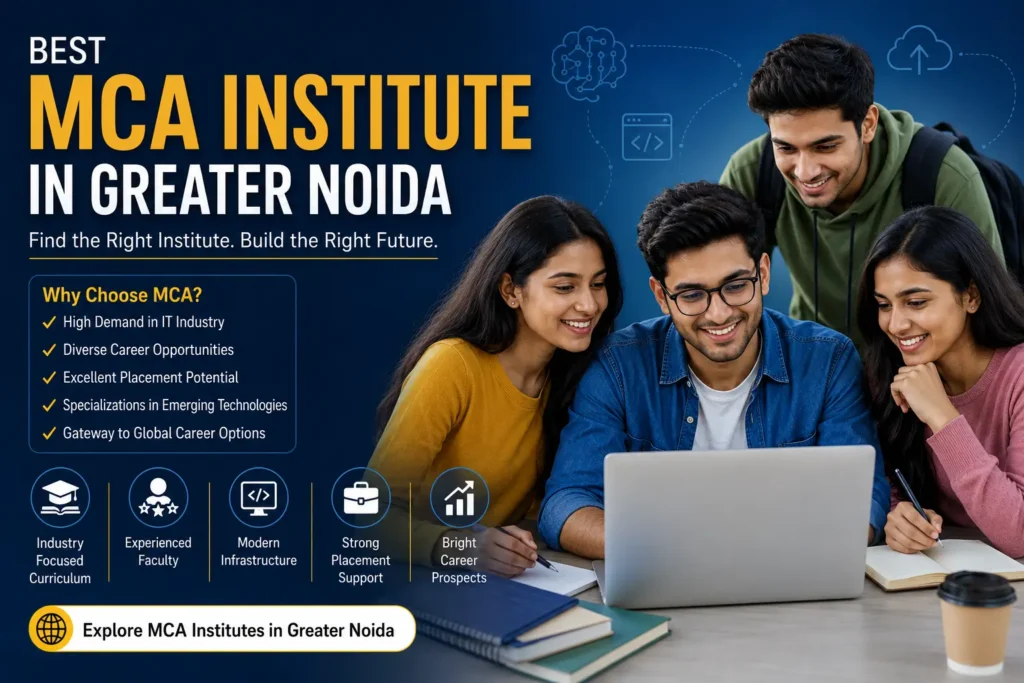

Best MCA Institute in Greater Noida
Choosing the right MCA institute is one of the most important decisions for students planning a successful career in software development, artificial intelligence, cloud computing, cybersecurity, and data science. While many institutions offer an MCA program, the overall learning experience depends on factors such as curriculum quality, faculty expertise, industry exposure, infrastructure, internship opportunities, and placement support.
Greater Noida has emerged as one of India’s leading education hubs, attracting students from across the country due to its modern campuses, proximity to major IT and corporate centers, and growing ecosystem of higher education institutions.
If you are planning MCA Admission 2026, this comprehensive guide will help you compare institutes, understand the admission process, evaluate placements, and make an informed decision based on your career goals rather than marketing claims.
Table of Contents
- Why Choose Greater Noida for MCA?
- Why MCA is a Smart Career Choice in 2026
- Features of a Good MCA Institute
- MCA Eligibility Criteria
- MCA Admission Process
- Top MCA Institutes in Greater Noida
- Fee Structure
- Placements
- Career Opportunities
- Salary After MCA
- Frequently Asked Questions
- Conclusion
Why Choose Greater Noida for MCA?
Greater Noida has developed into one of the fastest-growing education and technology destinations in North India. Its strategic location in the National Capital Region (NCR) gives students access to academic resources as well as internship and employment opportunities.
Several universities, engineering institutions, and professional colleges in the region offer MCA programs designed to align with current industry requirements.
Some key advantages include:
- Access to modern educational infrastructure
- Industry-oriented learning environment
- Growing startup ecosystem
- Better internship opportunities
- Connectivity with Noida, Delhi, and Gurugram
- Exposure to IT companies and corporate offices
- Technical workshops and hackathons
- Competitive academic ecosystem
These factors make Greater Noida a preferred destination for students pursuing postgraduate studies in computer applications.
Why Pursue MCA in 2026?
Technology continues to transform every industry, creating demand for professionals with advanced computing skills. An MCA degree prepares students for careers in software engineering, AI, cloud computing, cybersecurity, and data analytics.
1. Growing Demand for IT Professionals
Organizations across finance, healthcare, manufacturing, education, retail, and government sectors are expanding their digital capabilities, increasing the demand for skilled technology professionals.
2. Wide Career Opportunities
After completing an MCA, graduates can explore roles such as:
- Software Developer
- Full Stack Developer
- AI Engineer
- Data Analyst
- Machine Learning Engineer
- Cloud Engineer
- DevOps Engineer
- Cybersecurity Analyst
- Database Administrator
- IT Consultant
3. Industry-Relevant Curriculum
Many institutes now incorporate advanced technologies into their MCA curriculum, including:
- Artificial Intelligence
- Machine Learning
- Data Science
- Cloud Computing
- Cybersecurity
- Internet of Things (IoT)
- Blockchain
- Full Stack Development
- DevOps
- Generative AI fundamentals
4. Excellent Career Growth
Technology professionals often have opportunities to progress into senior technical, managerial, consulting, or entrepreneurial roles with experience and continuous upskilling.
What Makes an MCA Institute the Best?
Selecting the right institute requires evaluating multiple aspects rather than focusing on a single ranking.
Academic Excellence
Look for institutions that regularly update their curriculum to reflect changing industry needs and emerging technologies.
Experienced Faculty
Faculty members with academic expertise and industry experience can provide valuable mentorship, project guidance, and career advice.
Modern Infrastructure
An MCA institute should provide:
- Advanced computer laboratories
- High-speed internet
- Smart classrooms
- Digital libraries
- Innovation labs
- AI and cloud computing labs
- Coding clubs
- Seminar halls
Placement Support
Effective placement support includes:
- Campus recruitment drives
- Resume-building sessions
- Aptitude training
- Coding practice
- Mock interviews
- Soft skills development
- Internship assistance
Industry Exposure
Practical learning opportunities may include:
- Industrial visits
- Guest lectures by professionals
- Live projects
- Technical workshops
- Hackathons
- Certification programs
- Internship collaborations
Research & Innovation
Institutes that encourage research, innovation, and entrepreneurship help students build practical problem-solving skills and explore emerging technologies.
MCA Eligibility Criteria
Eligibility requirements differ across institutions, but many institutes generally require:
Educational Qualification
A recognized bachelor’s degree from a university or institution meeting the admission norms of the respective college.
Students from backgrounds such as:
- BCA
- B.Sc.
- B.Sc. (Computer Science/IT)
- B.Com.
- BBA
- BA
- Engineering
may be eligible, subject to institution-specific requirements.
Mathematics Requirement
Some institutions require Mathematics at the 10+2 level or during graduation. Candidates should verify the eligibility criteria of each institute before applying.
Minimum Academic Performance
Institutions may specify minimum qualifying marks or CGPA for admission. These requirements vary and should be confirmed through the official admission guidelines.
MCA Admission Process
The admission process generally follows these steps:
Step 1: Research Institutes
Compare institutes based on:
- Curriculum
- Faculty
- Infrastructure
- Placements
- Fees
- Industry collaborations
- Student reviews
- Alumni achievements
Step 2: Verify Eligibility
Before applying, ensure you satisfy the institute’s eligibility criteria and document requirements.
Step 3: Submit Application
Complete the online or offline application form within the specified timeline and provide accurate academic and personal details.
Step 4: Entrance Examination (Where Applicable)
Depending on the institute, admissions may be based on:
- National entrance examinations
- University entrance tests
- Merit-based admissions
Always check the specific admission policy of your chosen institute.
Step 5: Counselling & Document Verification
Shortlisted candidates may be invited for counselling, document verification, or personal interaction before admission is confirmed.
Step 6: Admission Confirmation
Selected candidates typically confirm their admission by paying the required fees and completing enrollment formalities within the prescribed deadline.
Documents Required
Applicants should generally keep the following documents ready:
Academic Documents
- Class 10 Mark Sheet
- Class 12 Mark Sheet
- Graduation Mark Sheets
- Degree Certificate/Provisional Certificate
Identity Documents
- Aadhaar Card
- PAN Card (if required)
Admission Documents
- Passport-size photographs
- Signature
- Entrance examination scorecard (if applicable)
- Transfer Certificate (if required)
- Migration Certificate (if required)
- Character Certificate
- Category Certificate (if applicable)
Why Students Should Compare Institutes Carefully
Every institute has its own strengths. Some may focus on research, while others emphasize practical training, placements, or affordability.
Before making a decision, compare:
- Curriculum relevance
- Faculty qualifications
- Internship opportunities
- Placement support
- Infrastructure
- Industry exposure
- Alumni network
- Fee structure
- Location advantages
- Return on Investment (ROI)
A balanced evaluation helps students choose an institute that aligns with their long-term career goals rather than simply selecting the most popular name.
Top MCA Institutes in Greater Noida, Specializations, Fees & Selection Guide
Top MCA Institutes in Greater Noida (2026)
Greater Noida is home to several institutions offering MCA programs with different strengths. Rather than choosing a college based solely on advertisements or rankings, compare academic quality, curriculum, faculty, infrastructure, internships, and placement support.
The following list is presented in alphabetical/reference style (not an official ranking).
| Institute | Key Highlights | Admission Mode |
|---|---|---|
| Accurate Institute of Management & Technology | Industry-oriented curriculum, technical events, placement support | Merit/University Norms |
| RBMI Group of Institutions, Greater Noida | AICTE-approved MCA, AKTU affiliation, industry-focused curriculum, modern labs, add-on certification programs, placement assistance, project-based learning | Merit/University Norms |
| Galgotias College of Engineering & Technology | Strong academic ecosystem, industry interaction, active coding culture | University Norms |
| GL Bajaj Institute of Technology & Management | Good reputation for technical education, placement preparation, modern infrastructure | University Norms |
| IILM University, Greater Noida | Industry collaborations, interdisciplinary learning, modern campus | University Norms |
| IIMT Group of Colleges | Technical programs with industry exposure and placement initiatives | University Norms |
| IEC College of Engineering & Technology | Computer application programs with practical learning opportunities | University Norms |
The Greater Noida region offers students multiple choices depending on their academic goals, budget, preferred learning environment, and career aspirations.
Why RBMI Group of Institutions Appears Among the Recommended Choices
Among the private MCA institutes in Greater Noida, RBMI Group of Institutions is one option students may consider because of its focus on practical learning, AICTE-approved MCA program, AKTU affiliation, updated computing facilities, and placement-oriented training. The institute also highlights add-on certifications, project work, and industry exposure as part of its MCA program. Students should independently compare these features with other colleges before making a final admission decision.
Institute Comparison
| Parameter | What You Should Compare |
|---|---|
| Curriculum | Latest technologies included |
| Faculty | Academic and industry experience |
| Infrastructure | Labs, classrooms, internet, library |
| Placement Support | Recruiters, internships, training |
| Industry Exposure | Workshops, seminars, live projects |
| Certifications | Value-added programs |
| Research | Innovation and project opportunities |
| Alumni | Success stories and industry presence |
| ROI | Fees compared with placement outcomes |
Popular MCA Specializations
Technology is evolving rapidly, and many institutes now offer specialized MCA pathways.
Artificial Intelligence
Students learn:
- Machine Learning
- Deep Learning
- Computer Vision
- Natural Language Processing
- AI Applications
Career Options
- AI Engineer
- Machine Learning Engineer
- AI Developer
Data Science
Key Subjects
- Data Analytics
- Big Data
- Statistics
- Python
- Visualization
Career Roles
- Data Scientist
- Data Analyst
- Business Intelligence Developer
Cybersecurity
Areas Covered
- Ethical Hacking
- Network Security
- Cloud Security
- Digital Forensics
- Security Operations
Career Roles
- Cybersecurity Analyst
- Information Security Engineer
- SOC Analyst
Cloud Computing
Students gain exposure to
- AWS
- Microsoft Azure
- Google Cloud
- Virtualization
- Cloud Deployment
Career Roles
- Cloud Engineer
- Cloud Consultant
- Infrastructure Engineer
Full Stack Development
Students develop applications using
- HTML
- CSS
- JavaScript
- React
- Node.js
- MongoDB
- SQL
Career Roles
- Full Stack Developer
- Software Engineer
- Web Developer
Data Analytics
Students learn
- SQL
- Excel
- Power BI
- Tableau
- Python Analytics
Career Roles
- Business Analyst
- Data Analyst
- Reporting Analyst
MCA Fee Structure in Greater Noida
Fees differ from one institution to another depending on facilities, infrastructure, affiliation, and additional training offered.
| Institute Type | Approximate Total Fee |
|---|---|
| Government Institutions | ₹60,000 – ₹1.5 Lakh |
| Government-Aided | ₹80,000 – ₹2 Lakh |
| Private Institutes | ₹1.2 Lakh – ₹3.5 Lakh+ |
The total cost may also include examination fees, library charges, laboratory fees, hostel, transportation, and other institutional expenses.
Students should always verify the latest fee structure directly with the institute before applying.
Scholarships Available
Many MCA institutes provide financial assistance through scholarships.
Common categories include:
- Merit Scholarships
- Girl Student Scholarships
- Sports Scholarships
- Government Scholarships
- SC/ST Scholarships
- OBC Scholarships
- EWS Scholarships
- Minority Scholarships
- Defence Category Scholarships
- Institutional Fee Waivers
How to Choose the Best MCA Institute
Instead of asking,
“Which college is number one?”
Ask these questions:
Does the curriculum include modern technologies?
A quality MCA program should cover
- AI
- Machine Learning
- Cloud Computing
- Cybersecurity
- DevOps
- Data Science
Does the institute emphasize practical learning?
Look for
- Live Projects
- Hackathons
- Coding Competitions
- Industrial Visits
- Workshops
Are placement activities conducted regularly?
Placement preparation should ideally include
- Aptitude Training
- Coding Sessions
- Mock Interviews
- Resume Building
- Group Discussions
Does the college have modern labs?
A good MCA institute should provide
- Programming Labs
- Networking Labs
- AI Labs
- Cloud Labs
- High-Speed Internet
- Digital Library
What is the Return on Investment?
A lower fee does not automatically mean better value.
Compare:
- Placement support
- Internship opportunities
- Skill development
- Industry exposure
- Alumni success
Common Admission Mistakes
Many students make avoidable mistakes while selecting an MCA institute.
Choosing Only by Advertisements
Promotional material should not replace independent research.
Ignoring Placement Preparation
College reputation alone does not guarantee employment.
Students should actively build:
- Coding skills
- Communication skills
- Technical projects
Not Comparing Curriculum
Modern employers increasingly value graduates with hands-on experience in AI, cloud computing, cybersecurity, and software development.
Missing Application Deadlines
Track
- Application forms
- Entrance exams
- Counselling
- Document verification
- Fee submission
carefully to avoid losing admission opportunities.
MCA Placements, Career Opportunities, Salary & Future Scope
MCA Placements in Greater Noida
One of the biggest questions every MCA aspirant asks is:
“Will I get good placement opportunities after completing my MCA?”
The answer depends on several factors—not just the college name. Your technical skills, internship experience, project portfolio, communication abilities, and interview preparation all play a major role in securing a good job.
Greater Noida has become a preferred destination for technical education because of its proximity to Noida, Delhi, Ghaziabad, and Gurugram, which together form one of India’s largest technology and corporate hubs. This location gives students access to internships, industrial visits, networking events, and campus recruitment opportunities.
Factors That Influence MCA Placements
Students should evaluate institutes based on their overall placement ecosystem rather than relying only on the highest salary package advertised.
Important factors include:
- Placement training programs
- Industry collaborations
- Internship opportunities
- Coding culture
- Technical workshops
- Alumni network
- Communication skill development
- Campus recruitment drives
- Industry certifications
Students who actively participate in these activities generally have stronger placement prospects.
Skills Recruiters Look for in MCA Graduates
Technology companies focus on practical knowledge and problem-solving ability.
Some of the most valued skills include:
Programming Languages
- Java
- Python
- C++
- JavaScript
- SQL
Computer Science Fundamentals
- Data Structures
- Algorithms
- Object-Oriented Programming
- Operating Systems
- Database Management Systems
- Computer Networks
Modern Technologies
Recruiters increasingly seek graduates familiar with:
- Artificial Intelligence
- Machine Learning
- Cloud Computing
- DevOps
- Cybersecurity
- Full Stack Development
- Data Analytics
- Generative AI tools
- REST APIs
- Git & GitHub
Soft Skills
Technical expertise should be complemented by:
- Communication
- Teamwork
- Leadership
- Presentation skills
- Analytical thinking
- Time management
- Adaptability
Top Recruiters Hiring MCA Graduates
Graduates from well-prepared MCA programs find opportunities across software services, consulting firms, product companies, startups, fintech organizations, and Global Capability Centres (GCCs).
Some well-known recruiters include:
- TCS
- Infosys
- Wipro
- HCLTech
- Accenture
- Cognizant
- Capgemini
- IBM
- LTIMindtree
- Deloitte
- Tech Mahindra
- Oracle
- SAP
- PwC
- EY
- KPMG
- Amazon
- Microsoft
- Adobe
Recruitment varies by company requirements, institute participation, market conditions, and candidate performance.
Typical Campus Placement Process
Most recruiters follow a structured hiring process.
Stage 1: Online Assessment
This usually tests:
- Aptitude
- Logical Reasoning
- English
- Computer Fundamentals
Stage 2: Coding Test
Students solve programming questions using languages such as:
- Java
- Python
- C++
- C
Stage 3: Technical Interview
Interviewers often ask about:
- Data Structures
- Algorithms
- DBMS
- Operating Systems
- Networking
- Software Engineering
- Personal Projects
- Internship Experience
Stage 4: HR Interview
This stage evaluates:
- Communication
- Confidence
- Teamwork
- Career goals
- Problem-solving approach
- Professional attitude
Career Opportunities After MCA
An MCA degree opens the door to a wide range of technology careers across industries.
Software Developer
Software developers design, develop, test, and maintain applications for businesses and consumers.
Typical Responsibilities:
- Application development
- Software testing
- Bug fixing
- Feature implementation
- System maintenance
Full Stack Developer
Full stack professionals work on both front-end and back-end development.
Popular Technologies:
- HTML
- CSS
- JavaScript
- React
- Angular
- Node.js
- Express
- MongoDB
- MySQL
Artificial Intelligence Engineer
AI engineers build intelligent systems capable of learning from data and automating complex tasks.
Key Skills:
- Python
- TensorFlow
- PyTorch
- Machine Learning
- Deep Learning
Data Scientist
Data scientists transform business data into actionable insights.
Required Skills:
- Python
- SQL
- Statistics
- Power BI
- Tableau
- Machine Learning
Cloud Engineer
Cloud professionals manage scalable computing infrastructure using platforms such as:
- AWS
- Microsoft Azure
- Google Cloud Platform
Cybersecurity Analyst
Cybersecurity specialists help organizations protect their systems and data.
Important Skills:
- Network Security
- Ethical Hacking
- Cloud Security
- SIEM Tools
- Incident Response
DevOps Engineer
DevOps engineers automate software development and deployment pipelines.
Popular Tools:
- Docker
- Kubernetes
- Jenkins
- Terraform
- GitHub Actions
Database Administrator
DBAs ensure databases remain secure, optimized, and highly available.
Common Technologies:
- Oracle
- MySQL
- PostgreSQL
- SQL Server
Mobile Application Developer
Developers create Android and iOS applications using:
- Kotlin
- Flutter
- React Native
- Swift
IT Consultant
Consultants advise organizations on technology implementation, digital transformation, and software solutions.
Emerging Career Paths
Technology continues to evolve rapidly, creating exciting opportunities for MCA graduates.
High-growth fields include:
- Artificial Intelligence
- Machine Learning
- Generative AI
- Prompt Engineering
- Data Engineering
- Cloud Architecture
- Cybersecurity
- Blockchain
- Internet of Things (IoT)
- Robotics Software
- Business Intelligence
- DevSecOps
Students who continue learning beyond the classroom are better positioned to enter these emerging domains.
Salary After MCA
Salary depends on several factors, including:
- Technical skills
- Internship experience
- College
- Certifications
- Company
- Location
- Interview performance
Indicative Salary Progression
| Experience Level | Typical Salary Range* |
|---|---|
| Freshers | ₹4–8 LPA |
| 2–4 Years | ₹8–15 LPA |
| 5–8 Years | ₹15–25 LPA |
| Senior Professionals | ₹25 LPA+ |
*These figures are indicative and vary based on employer, role, skill set, and market conditions.
Professionals with expertise in AI, cloud computing, cybersecurity, and advanced software engineering often command higher compensation due to the specialized nature of these roles.
Importance of Internships
Internships bridge the gap between classroom learning and industry expectations.
Benefits include:
- Practical experience
- Industry exposure
- Better resume
- Professional networking
- Improved interview confidence
- Stronger placement opportunities
Students should try to complete at least one meaningful internship before graduating.
Certifications That Add Value
Along with an MCA degree, certifications can strengthen your profile.
Popular options include:
- AWS Cloud Certifications
- Microsoft Azure Certifications
- Google Cloud Certifications
- Oracle Java Certifications
- Cisco Networking Certifications
- Red Hat Certifications
- Python Programming Certifications
- Cybersecurity Certifications
- Power BI Certifications
- Tableau Certifications
Choose certifications that align with your career interests rather than collecting multiple unrelated credentials.
Future Scope of MCA
The demand for skilled IT professionals remains strong as organizations continue investing in digital transformation.
Promising sectors include:
- Software Development
- Artificial Intelligence
- Cloud Computing
- Cybersecurity
- FinTech
- HealthTech
- EdTech
- E-commerce
- SaaS Companies
- Global Capability Centres (GCCs)
- Government Digital Services
- IT Consulting
Graduates who continuously update their technical knowledge, build real-world projects, and develop strong communication skills are likely to have broader career opportunities.
Tips to Maximize Your Placement Opportunities
Start preparing from the first semester instead of waiting until the final year.
Recommended activities:
- Practice coding regularly.
- Build a GitHub portfolio with original projects.
- Participate in hackathons and coding competitions.
- Complete internships during semester breaks.
- Improve communication and presentation skills.
- Learn modern development tools and frameworks.
- Stay informed about industry trends.
- Network with alumni and professionals through seminars and technical communities.
Admission Timeline, ROI, Expert Tips, FAQs & Conclusion
MCA Admission Timeline 2026 (Tentative)
While admission schedules differ from one institute to another, the overall admission cycle generally follows a similar pattern.
| Admission Activity | Tentative Timeline |
|---|---|
| Admission Notifications | January – March 2026 |
| Application Forms | February – May 2026 |
| Entrance Exams (where applicable) | April – June 2026 |
| Merit Lists / Results | May – July 2026 |
| Counselling & Document Verification | June – August 2026 |
| Fee Submission | July – August 2026 |
| Commencement of Classes | August – September 2026 |
Note: Candidates should always check the official websites of their preferred institutes for the latest admission schedules and eligibility criteria.
Step-by-Step Roadmap for MCA Aspirants
Step 1: Define Your Career Goal
Before selecting an institute, decide which field interests you the most.
Popular career domains include:
- Software Development
- Artificial Intelligence
- Data Science
- Cloud Computing
- Cybersecurity
- DevOps
- Full Stack Development
- Business Analytics
Choosing a career direction early helps you select the right electives, certifications, and internships.
Step 2: Shortlist the Right Institutes
Prepare a comparison sheet including:
- Curriculum
- Faculty
- Infrastructure
- Placement support
- Industry exposure
- Fee structure
- Scholarships
- Hostel facilities
- Location
- Alumni network
Avoid choosing an institute based solely on advertisements or social media promotions.
Step 3: Strengthen Technical Skills
Along with preparing for admission, invest time in learning:
Programming Languages
- Java
- Python
- C++
- SQL
Development Skills
- HTML
- CSS
- JavaScript
- Git
- APIs
- Database Design
Strong fundamentals will make classroom learning easier and improve placement readiness.
Step 4: Build a Portfolio
Recruiters increasingly value practical work.
Include:
- Personal software projects
- GitHub repositories
- Mini applications
- Hackathon participation
- Open-source contributions
- Technical blogs (optional)
A portfolio demonstrates your ability to apply concepts beyond examinations.
Step 5: Earn Relevant Certifications
Industry-recognized certifications can strengthen your profile in areas such as:
- Cloud Computing
- Python
- Java
- Data Analytics
- Cybersecurity
- AI Fundamentals
Prioritize certifications that complement your career goals.
Return on Investment (ROI)
When comparing MCA institutes, don’t focus only on tuition fees.
Evaluate the complete learning experience:
Academic Quality
- Updated curriculum
- Practical learning
- Faculty expertise
Career Development
- Internship opportunities
- Placement training
- Industry projects
- Soft skills development
Long-Term Value
- Alumni network
- Corporate collaborations
- Skill enhancement
- Career growth potential
A balanced combination of quality education, practical exposure, and career support often provides better long-term value than simply choosing the lowest-cost option.
Expert Tips Before Taking Admission
- Research every institute thoroughly.
- Verify approvals, affiliations, and accreditation.
- Read the latest admission brochure carefully.
- Speak with current students or alumni if possible.
- Compare placement support rather than only advertised salary packages.
- Develop coding skills before the first semester.
- Participate in technical communities and hackathons.
- Stay updated with AI, cloud, and cybersecurity trends.
- Keep all admission documents ready well in advance.
- Continue learning throughout your MCA journey.
Frequently Asked Questions (FAQs)
1. Which is the best MCA institute in Greater Noida?
There is no single institute that is ideal for every student. Compare institutes based on curriculum, faculty, infrastructure, placements, internships, affordability, and career support before making a decision.
2. Is Greater Noida a good place to study MCA?
Yes. Greater Noida has a well-developed educational ecosystem, modern campuses, and proximity to major IT and corporate hubs in the National Capital Region (NCR), providing students with access to internships and employment opportunities.
3. What is the eligibility for MCA admission?
Eligibility varies by institute. Generally, applicants should have a recognized bachelor’s degree and satisfy the institution’s specific academic requirements, which may include Mathematics at the 10+2 or graduation level.
4. Can I get admission to MCA without an entrance exam?
Some private institutions offer merit-based admissions, while many universities and government institutions require candidates to qualify through entrance examinations or university-specific selection processes.
5. What are the most popular MCA specializations?
Popular specializations include:
- Artificial Intelligence
- Data Science
- Cybersecurity
- Cloud Computing
- Full Stack Development
- Software Engineering
6. What is the average salary after MCA?
Salary depends on skills, internships, employer, location, and role. Graduates with practical experience and expertise in emerging technologies generally have stronger earning potential.
7. Are internships important during MCA?
Yes. Internships help students gain practical exposure, improve technical skills, build professional networks, and strengthen placement prospects.
8. Which skills should MCA students develop?
Students should focus on:
- Programming
- Data Structures & Algorithms
- Database Management
- Cloud Computing
- AI & Machine Learning
- Communication Skills
- Problem Solving
- Team Collaboration
9. How should I choose the right MCA institute?
Evaluate curriculum, faculty, placements, infrastructure, industry exposure, internship opportunities, alumni network, fee structure, and return on investment rather than relying only on rankings.
10. Is MCA still a good career choice in 2026?
Yes. MCA remains a valuable postgraduate program for students interested in software development, AI, cloud computing, cybersecurity, data science, and other technology-driven careers. Continuous learning and practical skill development are key to long-term success.
The best MCA institute in Greater Noida is one that combines an industry-relevant curriculum, experienced faculty, modern laboratories, internship opportunities, placement support, and a strong learning environment. Students should compare accreditation, infrastructure, career outcomes, and return on investment before selecting an institute. Practical skills, projects, internships, and continuous upskilling play a major role in career success after MCA.
Final Conclusion
Choosing the right MCA institute is an important investment in your future. While Greater Noida offers several reputed institutions, the best choice depends on your career goals, learning preferences, budget, and the type of opportunities you seek.
Instead of selecting a college based only on advertisements or popularity, evaluate the overall educational experience. Look for an institute that offers an updated curriculum, experienced faculty, practical training, internship support, modern infrastructure, and a structured placement ecosystem. These factors have a greater impact on your long-term growth than rankings alone.
As highlighted in this guide, institutes such as RBMI Group of Institutions, Greater Noida, along with several other established colleges in the region, provide MCA programs with different strengths. Comparing them objectively will help you make an informed decision that aligns with your aspirations.
Remember, an MCA degree is only the foundation. Your success will ultimately depend on how consistently you build technical expertise, complete meaningful projects, gain internship experience, earn relevant certifications, and stay updated with emerging technologies such as Artificial Intelligence, Cloud Computing, Cybersecurity, Data Science, and Full Stack Development.
With the right institute, a commitment to continuous learning, and a practical approach to skill development, you can build a rewarding career in India’s rapidly growing technology sector and beyond.