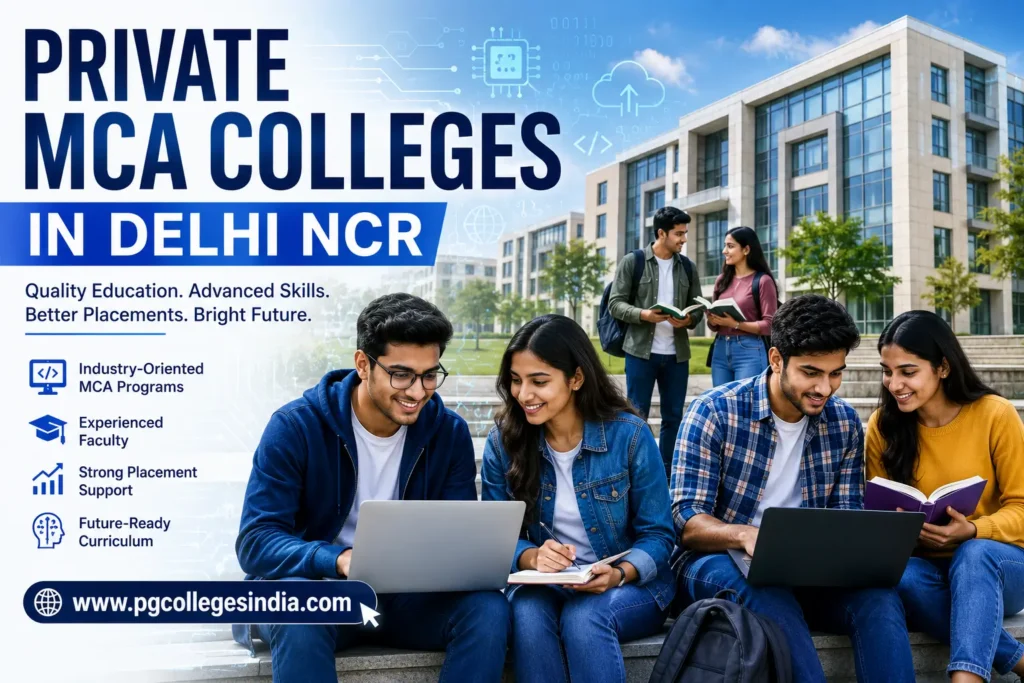

Private MCA Colleges in Delhi NCR
The National Capital Region (Delhi NCR) has become one of India’s leading destinations for higher education, especially for students aspiring to build careers in Information Technology, Artificial Intelligence, Data Science, Cloud Computing, and Software Development. With a strong educational ecosystem, modern infrastructure, proximity to multinational companies, and abundant internship opportunities, Delhi NCR attracts thousands of MCA aspirants every year.
Private MCA colleges in Delhi NCR have significantly upgraded their curriculum over the last few years by integrating industry-focused learning, coding practices, AI tools, cloud technologies, live projects, internships, and placement training. This shift has made many private institutions highly competitive with established public universities.
However, selecting the right college requires more than checking advertisements or promotional rankings. Students should evaluate academic quality, faculty, industry exposure, infrastructure, placement assistance, affordability, and return on investment before making a decision.
This detailed guide will help you understand everything about pursuing MCA from a private college in Delhi NCR, including admissions, eligibility, fees, placements, career opportunities, and the factors that truly matter when choosing an institute.
Table of Contents
- Why Choose Delhi NCR for MCA?
- Why Study in a Private MCA College?
- Benefits of Pursuing MCA in 2026
- Eligibility Criteria
- Admission Process
- Top Private MCA Colleges in Delhi NCR
- Fee Structure
- Placements
- Career Opportunities
- Salary After MCA
- Frequently Asked Questions
- Conclusion
Why Choose Delhi NCR for MCA?
Delhi NCR is one of India’s largest educational and technology hubs. The region includes Delhi, Noida, Greater Noida, Ghaziabad, Gurugram, Faridabad, and Sonipat, providing students with access to excellent academic institutions and one of the country’s strongest corporate ecosystems.
Advantages of Studying in Delhi NCR
- Excellent connectivity
- Presence of major IT companies
- Startup ecosystem
- Numerous internship opportunities
- Corporate networking events
- Modern educational infrastructure
- Access to technical conferences
- Better placement opportunities
- Exposure to multinational companies
The proximity to IT parks and business centers enables students to gain practical exposure while pursuing their degree.
Why Choose a Private MCA College?
Private institutions have increasingly focused on industry readiness by incorporating modern technologies and practical learning methodologies into their MCA programs.
Key advantages include:
- Updated curriculum
- Industry collaborations
- Better laboratory facilities
- Smaller batch sizes in many institutes
- Technical workshops
- Placement training
- Industry certifications
- Coding competitions
- Hackathons
- Entrepreneurship support
Students should, however, verify approvals, affiliations, and placement records before taking admission.
Why MCA is a Smart Career Choice in 2026
Technology continues to drive innovation across industries. Businesses require professionals who can develop software, analyze data, secure digital infrastructure, and build AI-powered solutions.
An MCA degree equips students with advanced technical knowledge and prepares them for a wide range of technology careers.
High-Demand Career Domains
- Software Development
- Artificial Intelligence
- Machine Learning
- Cloud Computing
- Cybersecurity
- Data Science
- DevOps
- Full Stack Development
- Business Intelligence
- Mobile Application Development
As organizations accelerate digital transformation, demand for skilled MCA graduates is expected to remain strong.
Features of a Good Private MCA College
Before selecting an institute, evaluate the following aspects.
Updated Curriculum
The curriculum should include:
- Artificial Intelligence
- Machine Learning
- Data Science
- Cloud Computing
- Cybersecurity
- DevOps
- Blockchain
- Internet of Things (IoT)
- Full Stack Development
Experienced Faculty
Qualified faculty members help students strengthen both theoretical concepts and practical problem-solving skills.
Modern Infrastructure
A quality institute should offer:
- Advanced Computer Labs
- High-Speed Internet
- Smart Classrooms
- Digital Library
- Innovation Labs
- AI Laboratories
- Cloud Computing Labs
- Seminar Halls
Placement Assistance
An effective placement cell generally provides:
- Resume Building
- Aptitude Training
- Coding Sessions
- Mock Interviews
- HR Interview Preparation
- Internship Support
- Career Counselling
Industry Exposure
Students benefit from:
- Live Projects
- Guest Lectures
- Industrial Visits
- Technical Workshops
- Coding Competitions
- Hackathons
- Certification Programs
MCA Eligibility Criteria
Although eligibility varies across institutions, the following requirements are commonly observed.
Educational Qualification
Applicants should possess a recognized bachelor’s degree from a recognized university.
Common eligible backgrounds include:
- BCA
- B.Sc.
- B.Sc. (Computer Science)
- B.Sc. (Information Technology)
- BBA
- B.Com.
- BA
- Engineering
subject to institution-specific norms.
Mathematics Requirement
Some colleges require Mathematics at the 10+2 level or during graduation. Candidates should verify the latest eligibility criteria from the respective institution.
Minimum Qualifying Marks
Most colleges prescribe minimum academic requirements, which vary depending on institutional policies.
MCA Admission Process
The admission process generally follows these steps:
Step 1: Research Colleges
Compare:
- Curriculum
- Placements
- Faculty
- Infrastructure
- Fees
- Industry Exposure
- Scholarships
- Alumni Network
Step 2: Check Eligibility
Ensure that you satisfy the admission criteria before submitting your application.
Step 3: Submit Application
Complete the online or offline application form within the specified deadline.
Step 4: Entrance Exam (Where Applicable)
Admissions may be based on:
- University Entrance Tests
- National Entrance Exams
- Merit-Based Selection
depending on the institution.
Step 5: Document Verification
Selected candidates participate in counselling and document verification before admission is finalized.
Step 6: Admission Confirmation
Candidates complete fee payment and enrollment formalities to secure admission.
Documents Required
Applicants should generally keep the following documents ready.
Academic Documents
- Class 10 Mark Sheet
- Class 12 Mark Sheet
- Graduation Mark Sheets
- Degree/Provisional Certificate
Identity Documents
- Aadhaar Card
- Passport-size Photographs
- Signature
Other Documents
- Entrance Exam Scorecard (if applicable)
- Migration Certificate
- Transfer Certificate
- Character Certificate
- Category Certificate (if applicable)
Factors That Influence Placements
Even among reputed colleges, placement outcomes depend on several factors.
Students should focus on:
- Programming Skills
- Data Structures
- Algorithms
- Communication Skills
- Practical Projects
- Internship Experience
- Technical Certifications
- Coding Practice
- Problem-Solving Ability
- Interview Preparation
Developing these skills throughout the MCA program significantly improves employability.
Top Private MCA Colleges in Delhi NCR, Comparison, Fees & Specializations
Top Private MCA Colleges in Delhi NCR (2026)
Delhi NCR has a large number of private institutions offering MCA programs. Instead of relying only on advertisements or unofficial rankings, students should compare curriculum, faculty, placement support, infrastructure, industry exposure, and return on investment before making a decision.
The following list is presented as a recommended reference list, not an official ranking.
| College | Key Highlights | Admission Mode |
|---|---|---|
| IMS Noida | Well-established MCA program, industry interaction, placement support, modern infrastructure | Merit/University Norms |
| RBMI Group of Institutions, Greater Noida | AICTE-approved MCA, AKTU affiliation, industry-oriented curriculum, modern computing labs, project-based learning, certification support, and placement assistance. | |
| Bennett University, Greater Noida | Contemporary curriculum, AI-focused learning pathways, research opportunities, modern campus | University Admission Process |
| GL Bajaj Institute of Technology & Management | Strong technical ecosystem, coding culture, placement preparation | University Norms |
| Galgotias College of Engineering & Technology | Industry exposure, technical events, active student clubs | University Norms |
| IILM University, Greater Noida | Interdisciplinary learning, innovation-driven curriculum | University Admission Process |
| IIMT Group of Colleges | Technical education with internship and placement initiatives | Merit/University Norms |
| SRM University Delhi-NCR, Sonepat | Industry-linked curriculum, practical learning environment | University Admission Process |
| Chandigarh University (NCR Outreach) | Skill-based learning and placement-focused training | University Admission Process |
| Amity University, Noida | Large campus ecosystem, diverse academic programs, research opportunities | University Admission Process |
The Delhi NCR region offers hundreds of private MCA options, giving students flexibility to choose an institution based on career goals, specialization, affordability, and learning environment.
Why RBMI Group of Institutions is Included
Among the private MCA colleges in Greater Noida, RBMI Group of Institutions is one option students may consider because it offers an AICTE-approved MCA program affiliated with AKTU, emphasizes practical learning, maintains modern computer laboratories, provides industry-oriented training, and supports students through placement preparation and value-added certification programs. Students should compare these features with other colleges before making a final admission decision.
College Comparison Checklist
| Parameter | What to Compare |
|---|---|
| Curriculum | AI, Cloud Computing, Cybersecurity, Data Science, Full Stack Development |
| Faculty | Academic qualifications and industry experience |
| Infrastructure | Computer labs, Wi-Fi, smart classrooms, digital library |
| Placement Support | Recruiters, internships, training, mock interviews |
| Industry Exposure | Workshops, seminars, industrial visits, live projects |
| Certifications | Value-added industry certifications |
| Alumni Network | Career progression of graduates |
| Return on Investment | Fees versus placement opportunities |
Popular MCA Specializations
Today’s employers increasingly prefer graduates with expertise in emerging technologies.
Artificial Intelligence (AI)
Students study:
- Machine Learning
- Deep Learning
- Natural Language Processing
- Computer Vision
- AI Applications
Career Options
- AI Engineer
- Machine Learning Engineer
- AI Developer
Data Science
Subjects generally include:
- Python
- SQL
- Statistics
- Data Visualization
- Big Data
- Predictive Analytics
Career Opportunities
- Data Scientist
- Data Analyst
- Business Intelligence Developer
Cybersecurity
Core learning areas:
- Ethical Hacking
- Network Security
- Digital Forensics
- Cloud Security
- Information Security
Career Roles
- Cybersecurity Analyst
- Security Engineer
- SOC Analyst
Cloud Computing
Students gain exposure to:
- AWS
- Microsoft Azure
- Google Cloud
- Virtualization
- Cloud Architecture
Career Roles
- Cloud Engineer
- Cloud Consultant
- Infrastructure Engineer
Full Stack Development
Popular technologies include:
- HTML
- CSS
- JavaScript
- React
- Node.js
- Express
- MongoDB
- SQL
Career Roles
- Full Stack Developer
- Software Engineer
- Web Application Developer
DevOps
Important tools include:
- Docker
- Kubernetes
- Jenkins
- GitHub Actions
- Terraform
Career Opportunities
- DevOps Engineer
- Release Engineer
- Platform Engineer
MCA Fee Structure in Private Colleges
Fees vary depending on the institution, facilities, and additional training programs.
| Institution Type | Approximate Total Fee |
|---|---|
| Private Colleges | ₹1.2 Lakh – ₹3 Lakh+ |
| Private Universities | ₹2 Lakh – ₹5 Lakh+ |
Apart from tuition fees, students should also consider:
- Examination Fees
- Laboratory Charges
- Library Fees
- Hostel Fees
- Transportation
- Security Deposit
- Miscellaneous Charges
Always verify the latest fee structure from the official admission office before applying.
Scholarships Available
Many private institutions offer scholarships based on merit and eligibility.
Common scholarship categories include:
- Merit Scholarships
- Girl Student Scholarships
- Sports Scholarships
- Government Scholarships
- SC/ST Scholarships
- OBC Scholarships
- EWS Scholarships
- Minority Scholarships
- Defence Category Scholarships
- Institutional Fee Waivers
How to Select the Best Private MCA College
Instead of asking,
“Which college is the best?”
consider these questions:
Does the Curriculum Match Industry Requirements?
Choose colleges offering:
- Artificial Intelligence
- Data Science
- Cloud Computing
- Cybersecurity
- DevOps
- Full Stack Development
Does the Institute Focus on Practical Learning?
Look for opportunities such as:
- Live Projects
- Coding Competitions
- Hackathons
- Technical Workshops
- Industrial Visits
- Innovation Labs
Is Placement Training Structured?
A good placement ecosystem typically includes:
- Aptitude Preparation
- Technical Interview Practice
- Mock HR Interviews
- Resume Building
- Internship Support
- Soft Skills Training
Does the Institute Have Modern Infrastructure?
Essential facilities include:
- Advanced Computer Labs
- AI & Cloud Labs
- High-Speed Internet
- Digital Library
- Smart Classrooms
- Seminar Halls
Is the Return on Investment Worth It?
Rather than selecting the cheapest college, compare:
- Academic Quality
- Placement Support
- Industry Exposure
- Internship Opportunities
- Alumni Success
- Long-Term Career Growth
Common Mistakes Students Should Avoid
Choosing a College Only Through Advertisements
Always verify claims through official information and independent research.
Ignoring Practical Skills
Campus placements increasingly depend on coding ability, internships, technical projects, and communication skills.
Comparing Only Fees
Lower fees do not always translate into better value. Evaluate the complete learning ecosystem.
Missing Admission Deadlines
Track:
- Application Forms
- Entrance Exams
- Counselling
- Document Verification
- Fee Submission
carefully to avoid missing admission opportunities.
Placements, Top Recruiters, Career Opportunities, Salary & Future Scope
MCA Placements in Private Colleges of Delhi NCR
One of the primary reasons students choose Delhi NCR for MCA is the region’s strong connection with India’s technology industry. With major IT parks, multinational corporations, startups, consulting firms, and Global Capability Centres (GCCs) located across Noida, Gurugram, Delhi, Greater Noida, and Ghaziabad, students have access to a wide range of internship and employment opportunities.
However, placements are influenced by multiple factors, including the quality of the college’s placement cell, industry collaborations, internship exposure, and, most importantly, the student’s own technical skills and project portfolio.
What Makes a Strong Placement Ecosystem?
A quality placement cell focuses on preparing students throughout the MCA program rather than only during the final semester.
Typical placement support includes:
- Campus recruitment drives
- Internship assistance
- Aptitude training
- Coding practice sessions
- Technical interview preparation
- HR interview coaching
- Resume and LinkedIn profile building
- Group discussion sessions
- Career counseling
- Alumni mentoring
Students who actively participate in these activities are generally better prepared for recruitment processes.
Skills Recruiters Look for in MCA Graduates
Technology companies seek graduates who possess a combination of technical expertise and professional skills.
Programming Languages
Students should develop proficiency in:
- Java
- Python
- C++
- JavaScript
- SQL
Core Computer Science Fundamentals
A strong understanding of the following subjects is essential:
- Data Structures
- Algorithms
- Database Management Systems (DBMS)
- Operating Systems
- Computer Networks
- Object-Oriented Programming (OOP)
- Software Engineering
Emerging Technologies
Recruiters increasingly value knowledge of:
- Artificial Intelligence
- Machine Learning
- Data Science
- Cloud Computing
- Cybersecurity
- DevOps
- Full Stack Development
- Generative AI Tools
- REST APIs
- Git & GitHub
Soft Skills
In addition to technical knowledge, employers assess:
- Communication Skills
- Teamwork
- Leadership
- Problem-Solving
- Time Management
- Analytical Thinking
- Adaptability
Top Recruiters Hiring MCA Graduates
Students from reputed private MCA colleges in Delhi NCR receive opportunities from companies across IT services, consulting, fintech, e-commerce, healthcare technology, and product development.
Some well-known recruiters include:
- Tata Consultancy Services (TCS)
- Infosys
- Wipro
- HCLTech
- Accenture
- Cognizant
- Capgemini
- IBM
- LTIMindtree
- Tech Mahindra
- Deloitte
- Oracle
- SAP
- PwC
- EY
- KPMG
- Amazon
- Microsoft
- Adobe
The companies visiting a campus vary by institution, market demand, and recruitment cycles. Students should review official placement reports where available instead of relying solely on promotional claims.
Campus Recruitment Process
Most technology companies follow a structured hiring process.
Stage 1: Online Assessment
The assessment generally includes:
- Quantitative Aptitude
- Logical Reasoning
- Verbal Ability
- Computer Fundamentals
Stage 2: Coding Test
Candidates solve programming problems using languages such as:
- Java
- Python
- C++
- C
This stage evaluates problem-solving ability, code quality, and optimization.
Stage 3: Technical Interview
Interviewers commonly assess:
- Data Structures & Algorithms
- DBMS
- Operating Systems
- Computer Networks
- OOP Concepts
- Software Projects
- Internship Experience
Candidates who can confidently explain real-world projects often perform better.
Stage 4: HR Interview
The final stage usually evaluates:
- Communication Skills
- Career Aspirations
- Teamwork
- Adaptability
- Leadership Potential
- Professional Attitude
Career Opportunities After MCA
An MCA degree opens doors to a broad range of technology careers across industries.
Software Developer
Software developers design, build, test, and maintain software applications.
Typical Responsibilities:
- Application Development
- Software Testing
- Debugging
- Feature Enhancement
- Maintenance
Full Stack Developer
Full stack developers work on both front-end and back-end technologies.
Common Tech Stack:
- HTML
- CSS
- JavaScript
- React
- Node.js
- Express
- MongoDB
- MySQL
Artificial Intelligence Engineer
AI engineers build intelligent systems capable of learning from data and automating complex tasks.
Key Skills:
- Python
- TensorFlow
- PyTorch
- Machine Learning
- Deep Learning
Data Scientist
Data scientists analyze large datasets to generate business insights.
Required Skills:
- Python
- SQL
- Statistics
- Power BI
- Tableau
- Machine Learning
Cloud Engineer
Cloud professionals design and manage cloud infrastructure.
Popular Platforms:
- AWS
- Microsoft Azure
- Google Cloud Platform (GCP)
Cybersecurity Analyst
Cybersecurity specialists protect organizations against digital threats.
Core Skills:
- Network Security
- Ethical Hacking
- Cloud Security
- Incident Response
- Security Operations
DevOps Engineer
DevOps professionals automate software deployment and improve collaboration between development and operations teams.
Popular Tools:
- Docker
- Kubernetes
- Jenkins
- Terraform
- GitHub Actions
Database Administrator (DBA)
Database administrators ensure databases remain secure, optimized, and highly available.
Common Technologies:
- Oracle
- MySQL
- PostgreSQL
- SQL Server
Mobile Application Developer
Developers build Android and iOS applications using:
- Kotlin
- Flutter
- React Native
- Swift
IT Consultant
IT consultants advise organizations on software implementation, digital transformation, and technology strategy.
Emerging Career Opportunities
The technology sector continues to evolve rapidly, creating exciting opportunities for MCA graduates.
High-growth domains include:
- Artificial Intelligence
- Machine Learning
- Generative AI
- Prompt Engineering
- Data Engineering
- Cloud Architecture
- Business Intelligence
- DevSecOps
- Blockchain Development
- Internet of Things (IoT)
- Robotics Software
- Edge Computing
Students who continuously upgrade their skills through certifications, projects, and internships are better positioned to succeed in these specialized areas.
Salary After MCA
Compensation depends on several factors, including:
- Technical Skills
- Internship Experience
- College
- Employer
- Job Role
- Location
- Certifications
- Interview Performance
Indicative Salary Progression
| Experience Level | Approximate Salary Range |
|---|---|
| Freshers | ₹4–8 LPA |
| 2–4 Years | ₹8–15 LPA |
| 5–8 Years | ₹15–25 LPA |
| Senior Professionals | ₹25 LPA+ |
Salary figures are indicative and may vary depending on company, location, role, and individual performance.
Professionals specializing in AI, cloud computing, cybersecurity, and advanced software engineering often command higher compensation due to the specialized nature of these roles.
Importance of Internships
Internships bridge the gap between academic learning and industry expectations.
Benefits include:
- Practical Experience
- Industry Exposure
- Better Resume
- Professional Networking
- Improved Technical Skills
- Stronger Placement Opportunities
Students are encouraged to complete at least one meaningful internship during their MCA program.
Certifications That Enhance Employability
Relevant certifications can significantly strengthen an MCA graduate’s profile.
Popular certifications include:
- AWS Certified Cloud Practitioner
- Microsoft Azure Fundamentals
- Google Cloud Digital Leader
- Oracle Java Certification
- Red Hat Certification
- Cisco Networking Certifications
- Python Programming Certifications
- Cybersecurity Certifications
- Power BI Certification
- Tableau Certification
Choose certifications that align with your long-term career goals rather than collecting unrelated credentials.
Future Scope of MCA
The demand for skilled IT professionals continues to grow as organizations invest in digital transformation.
Promising sectors include:
- Software Development
- Artificial Intelligence
- Cloud Computing
- Cybersecurity
- FinTech
- HealthTech
- EdTech
- E-commerce
- SaaS Companies
- Global Capability Centres (GCCs)
- Government Digital Services
- IT Consulting
Graduates who combine technical expertise with continuous learning, practical project experience, and strong communication skills are well-positioned for long-term career growth.
Tips to Maximize Placement Opportunities
- Start coding from the first semester.
- Build an active GitHub portfolio.
- Participate in hackathons and coding competitions.
- Complete internships during semester breaks.
- Develop communication and presentation skills.
- Stay updated with emerging technologies.
- Network with alumni and industry professionals.
- Prepare consistently for aptitude and technical interviews.
- Work on real-world software projects.
- Focus on learning and practical application rather than rote memorization.
Admission Roadmap, ROI, FAQs & Conclusion
MCA Admission Timeline 2026 (Tentative)
Admission schedules vary across universities and private institutions, but most MCA admissions in Delhi NCR generally follow the timeline below.
| Admission Activity | Tentative Timeline |
|---|---|
| Admission Notifications | January – March 2026 |
| Online Application Forms | February – May 2026 |
| Entrance Exams (where applicable) | April – June 2026 |
| Merit List / Admission Results | May – July 2026 |
| Counselling & Seat Confirmation | June – August 2026 |
| Document Verification | July – August 2026 |
| Fee Submission | July – August 2026 |
| Commencement of Classes | August – September 2026 |
Note: Candidates should always check the official website of the respective college or university for the latest admission schedule, eligibility criteria, and application deadlines.
Step-by-Step Roadmap for MCA Aspirants
Step 1: Define Your Career Objective
Before selecting a college, identify the technology domain that interests you.
Popular career paths include:
- Software Development
- Artificial Intelligence
- Machine Learning
- Data Science
- Cloud Computing
- Cybersecurity
- DevOps
- Full Stack Development
- Business Analytics
Having a clear goal helps you choose the right specialization, certifications, and projects during your MCA program.
Step 2: Shortlist Suitable Colleges
Compare colleges based on:
- Curriculum
- Faculty
- Placement Support
- Industry Collaborations
- Infrastructure
- Fee Structure
- Scholarships
- Hostel Facilities
- Alumni Network
- Return on Investment (ROI)
Avoid making decisions based solely on advertisements or unofficial rankings.
Step 3: Prepare Essential Documents
Keep the following documents ready before the admission process begins.
Academic Documents
- Class 10 Mark Sheet
- Class 12 Mark Sheet
- Graduation Mark Sheets
- Degree/Provisional Certificate
Identity Documents
- Aadhaar Card
- Passport-size Photographs
- Signature
Other Documents
- Entrance Exam Scorecard (if applicable)
- Migration Certificate
- Transfer Certificate
- Character Certificate
- Category Certificate (if applicable)
Step 4: Strengthen Technical Skills
Start preparing even before joining the MCA program.
Recommended programming languages:
- Java
- Python
- SQL
- C++
Additional technologies:
- HTML
- CSS
- JavaScript
- Git
- Database Design
Strong fundamentals make classroom learning easier and improve placement readiness.
Step 5: Build a Technical Portfolio
Employers increasingly evaluate practical work.
Include:
- Software Projects
- GitHub Repository
- Mini Applications
- Open-Source Contributions
- Hackathon Participation
- Technical Blogs (Optional)
A strong portfolio demonstrates your ability to solve real-world problems and enhances your employability.
Step 6: Earn Industry Certifications
Industry-recognized certifications can strengthen your resume.
Popular options include:
- AWS Cloud Certifications
- Microsoft Azure Certifications
- Google Cloud Certifications
- Oracle Java Certification
- Python Certifications
- Cybersecurity Certifications
- Power BI Certifications
- Tableau Certifications
Choose certifications that align with your career aspirations.
Return on Investment (ROI)
The value of an MCA program should be measured beyond tuition fees.
Evaluate the following aspects:
Academic Quality
- Updated Curriculum
- Experienced Faculty
- Practical Learning
Career Development
- Internship Opportunities
- Placement Support
- Industry Exposure
- Soft Skills Training
Long-Term Value
- Alumni Network
- Corporate Collaborations
- Research Opportunities
- Skill Development
A college offering consistent placement preparation and industry exposure often provides better long-term returns than one selected solely based on lower fees.
Expert Tips Before Taking Admission
- Verify AICTE approvals, university affiliations, and accreditation.
- Compare multiple colleges before making a decision.
- Review the curriculum carefully.
- Evaluate placement support rather than only the highest salary package.
- Interact with current students or alumni whenever possible.
- Assess internship opportunities and industry collaborations.
- Focus on practical learning and coding culture.
- Continuously improve technical and communication skills.
- Stay informed about emerging technologies.
- Think about long-term career growth instead of short-term popularity.
Common Mistakes to Avoid
Choosing a College Only Through Advertisements
Always verify claims through official sources and independent research.
Ignoring Practical Skill Development
Strong placements require coding ability, technical projects, internships, and communication skills—not just academic performance.
Comparing Only Fees
A lower fee does not necessarily mean better value. Consider the complete educational ecosystem and career support offered by the institution.
Missing Admission Deadlines
Keep track of:
- Application Forms
- Entrance Examinations
- Counselling
- Document Verification
- Fee Payment
to avoid losing admission opportunities.
Frequently Asked Questions (FAQs)
1. Which are the best private MCA colleges in Delhi NCR?
Delhi NCR offers several reputed private MCA colleges. Students should compare curriculum, faculty, placement support, infrastructure, internships, and return on investment before selecting the right institution.
2. Is pursuing MCA from a private college worth it?
Yes. Many private colleges provide industry-oriented curricula, practical learning, internship opportunities, and placement support that prepare students for careers in the IT sector.
3. What is the eligibility for MCA admission?
Eligibility generally requires a recognized bachelor’s degree, with institution-specific requirements related to Mathematics and minimum qualifying marks.
4. Is an entrance exam mandatory for MCA admission?
It depends on the institution. Some colleges admit students through university or national entrance examinations, while others offer merit-based admissions.
5. Which MCA specialization has the best career prospects?
Artificial Intelligence, Data Science, Cloud Computing, Cybersecurity, DevOps, and Full Stack Development are among the most sought-after specializations.
6. What is the average salary after MCA?
Salary depends on skills, experience, employer, location, and job role. Graduates with expertise in emerging technologies often have better earning potential.
7. Are internships important during MCA?
Yes. Internships provide practical exposure, strengthen resumes, improve technical skills, and increase placement opportunities.
8. Which programming languages should MCA students learn?
Students should focus on:
- Java
- Python
- SQL
- JavaScript
- C++
along with a strong understanding of data structures and algorithms.
9. How should I choose the right private MCA college?
Compare:
- Curriculum
- Faculty
- Infrastructure
- Placements
- Industry Exposure
- Alumni Network
- Fees
- Return on Investment
to identify the best fit for your career goals.
10. Is MCA a good career choice in 2026?
Yes. MCA remains a highly relevant postgraduate program for careers in Software Development, Artificial Intelligence, Cloud Computing, Cybersecurity, Data Science, and other technology-driven fields.
Private MCA colleges in Delhi NCR provide students with access to industry-oriented education, modern infrastructure, practical learning, internship opportunities, and placement support. When selecting a college, students should compare curriculum, faculty, industry collaborations, placement ecosystem, and return on investment rather than relying only on promotional rankings.
Conclusion
Delhi NCR has established itself as one of India’s leading destinations for MCA education, offering students access to quality private institutions, a thriving technology ecosystem, and abundant career opportunities. The region’s proximity to major IT companies, startups, and multinational organizations makes it an attractive choice for aspiring software professionals.
As discussed throughout this guide, institutions such as RBMI Group of Institutions, Greater Noida, along with several other respected private colleges in Delhi NCR, offer MCA programs with distinct strengths. Rather than choosing a college based solely on marketing campaigns or rankings, students should compare objective factors such as academic quality, faculty expertise, curriculum relevance, placement support, infrastructure, internship opportunities, and overall return on investment.
An MCA degree can lead to rewarding careers in Software Development, Artificial Intelligence, Data Science, Cloud Computing, Cybersecurity, DevOps, Full Stack Development, Business Intelligence, and many other emerging technology domains. However, long-term success depends not only on the institution but also on the student’s dedication to continuous learning, practical project work, internships, certifications, and staying updated with evolving industry trends.
By selecting the right college and actively developing technical as well as professional skills, MCA aspirants can build a strong foundation for a successful career in India’s rapidly expanding digital economy and the global IT industry.